
The Old People Had a Saying for Everything: 15 Guyanese Proverbs and Sayings

In Guyana, there is a saying for everything and everyone. And growing up, it seemed there was a name for everyone, too—whether they liked it or not.
I still remember some people on my street by their “false names,” as we called them back then. Some of their real names? I couldn’t tell you. There was Golden Boy, who transported goods around the city with his horse and cart. Perhaps he got his name from the horse—I can’t say for sure. Then there was an older taxi driver called 42 Cents (you needed exact change to ride with him), and a schoolmate some cruelly called One For Today Two For Tomorrow.
I myself was called Bird Legs. I know.
But beyond the names we called one another were the sayings passed down from one generation to the next. Those had a much longer reach. Leave home, cross an ocean, grow older, and somehow, the old people are still in your head, telling you about yourself.
I can still hear my great-aunt Mother—yep, that was her name—saying, “Bird fly too fast, he gun fly past he nest,” when she thought we were getting out of line. My maternal grandmother had her own warning: “You better know your onion.”
The bird might have been imaginary. The warning was not.
Where did these sayings come from?
Guyanese proverbs belong to a rich oral tradition, with strong African roots. Passed along through conversation, storytelling, and family life, they offered advice, corrected behavior, and delivered warnings in a few memorable words. Some are shared across the Caribbean, with variations in wording and meaning.
We learned proverbs in school, too. At home, though, the lesson could arrive without warning and you might be the reason it was being taught.
Here are fifteen proverbs and sayings I grew up hearing. Perhaps they’ll stir a few memories of your own.
The explanations reflect how I understand them. Someone from another part of Guyana—or even another household down the street—might remember things differently.
And a word about the spelling: we weren’t taught to write Creolese (or Guyana Creole as some call it) when I was growing up. I’m writing these expressions as I remember hearing them.
Fifteen sayings, plenty of advice
1. “Yuh run from the jumbie (zombie) and butt up with the ol’ higue.”
You escape one bad situation only to find yourself in something worse. You leave a toxic relationship, breathe a sigh of relief, and then discover the next person has brought a whole new set of problems.
So much for the escape.
2. “Know your onion.”
As I remember hearing it, this meant knowing who you were dealing with—and being careful who you chose to trouble.
Before you decide to get bold with somebody, know your onion.
3. “Hand wash hand, mek hand clean.”
Helping someone else can benefit you, too. Cooperation gets things done, whether you’re looking after family, helping a neighbor, or trying to improve the whole community.
A few words, and there’s your lesson in working together.
4. “Every skin teeth ah na laff.”
Just because somebody is smiling doesn’t mean they’re pleased with you. And because they laughed at your joke doesn’t mean they thought it was funny.
Sometimes the teeth are showing, but the friendship is questionable.
5. “Moon ah run til day katch him.”
You might get away with something for a long time, but eventually it catches up with you.
The old people didn’t need to explain consequences at length. They had the moon working on it.
6. “Do suh nah like suh.”
Some people are very comfortable dishing out behavior they cannot stand receiving.
Before you mistreat someone, consider how you would feel if the same thing came back your way. Funny how quickly the rules change when it’s your turn.
7. “Bird fly too fast, he fly past he nest.”

This was one of Aunt Mother’s warnings when we were getting too forward or forgetting ourselves.
As I understood it: mind how you carry on. You could get ahead of yourself and land in trouble.
8. “Monkey know which limb fuh jump pun.”
People often know exactly who they can push around.
Notice how someone who is rude and overbearing with one person can suddenly find their manners with another? Monkey knows.
9. “One, one dutty build dam.”
Little by little, you can accomplish something substantial. Every small effort adds up.
Save a little money. Write another page. Take the next step. You might not see the whole dam yet, but keep going.
10. “Don’t tek your eyes and pass me.”
This was a demand for respect. Don’t look at me and decide I’m somebody you can dismiss, insult, or speak to any way you please.
If someone said this to you, the conversation had probably already taken a turn.
11. “Monkey dress pickney till he spoil em.”
I understood this as a warning about pampering a child until you spoil them—even when your intentions are good.
It is also explained as a warning against overdoing something: you keep adding, fixing, and fussing until you make things worse. Either way, there comes a point when you need to leave well enough alone.
12. “Bush got ears, and dutty got tongue.”
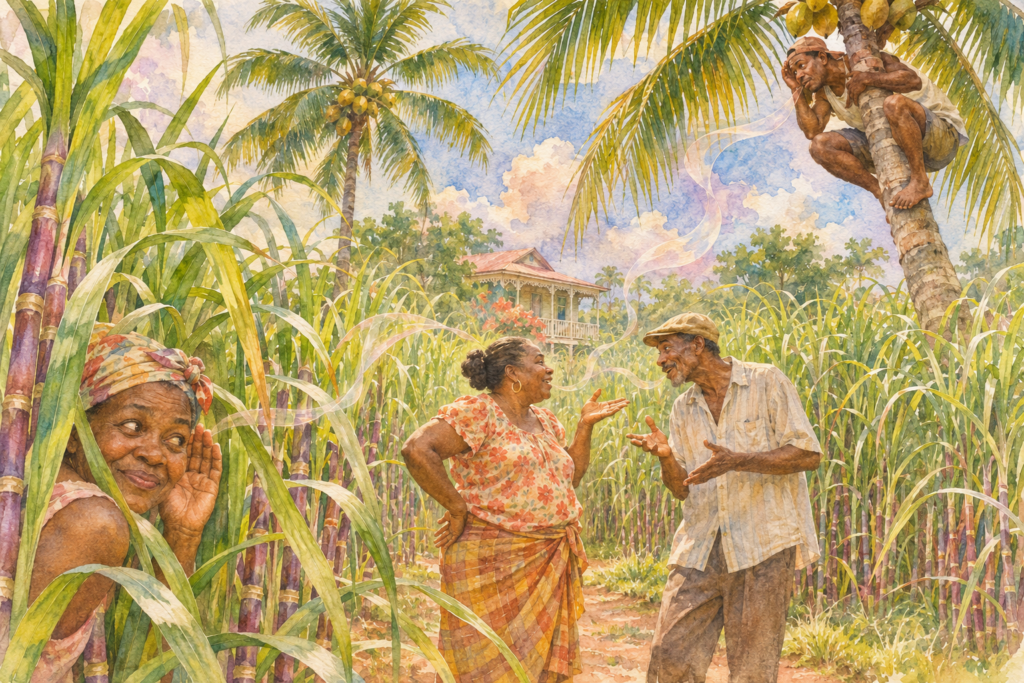
Be careful what you say and where you say it. You may think nobody is listening, but somehow your business can find its way around the place.
And when it comes back to you, it might have acquired a few extra details.
13. “Leff han na know wha right han do.”
People who should be sharing information are doing their own thing, leaving everyone confused.
One person tells you yes, another tells you no, and a third has never heard of the matter. We’ve all been in that office.
14. “Yuh jump out dee fryin’ pan into the fire.”
You leave something bad and end up in something worse.
It’s much the same warning as the jumbie (zombie) and the ol’ higue. Apparently, we needed more than one way to describe a decision that did not work out.
15. “Monkey see, monkey do.”
Someone copies another person without giving much thought to what they’re doing.
It could be children following their friends or grown people trying to keep up with the neighbors. Age doesn’t necessarily cure it.
I can still hear them
Some of these sayings make me laugh now. Others make more sense than they did when I was young.
Back then, I might have been too busy feeling scolded to appreciate the wisdom. Now I find myself remembering the words and the people who said them.
Especially Aunt Mother and my grandmother. All these years later, I can still hear them telling me to mind my p’s and q’s. Yet another saying! Girl, don’t mek me laf.